Friday, 16 August 2013
Team Video

Wednesday, 7 August 2013
Jerusalem, the Holy City
We have been in Jerusalem for a week and a half, enjoying the sights and learning biblical history through Caleb Thomason.
Here's what I read about in the news this morning.

The U.S. closed down 22 of their embassies across the Middle East and North Africa this week due to "credible threats" from al Qaeda...
Welcome to the Middle East PhotogenX!!!
Our time here has been a little challenging with riots, flash bombs, aggressive people, bed bugs and people who cheat with money. On the contrary we've also experienced great food, comfy cafe's, good teaching, fantastic sights, bonding time at the laundry mat and met a whole variety of lovely people.
Friday, 2 August 2013
Short Biography of an Iraqi Refugee
Azaldeen Seff
A Short Biography of an Iraqi Refugee

“Since I have seen what this world is like, I have no dreams. Do you know the feeling when you wish to cry and you can’t? It’s so hard. I wish to cry.”
His hands covered his face, his eyes were moist with tears, and his voice strained to gain composure as we sat together in a living room in Amman, Jordan.
Azaldeen had been waiting for 45 minutes in the hot sun during Ramadan for us to pick him up. We were late and he was hot, thirsty and unable to drink anything, but he had jumped into the car with a smile on his face, thankful for the ride.
The first time we met was at a roof-top cafe on Rainbow Street. People were enjoying a variety of food and drink, smoking the traditional shisha after the sun went down. Our group was settled in the corner comfortably sipping tea and filling the cool evening air with conversation and laughter. He and two friends arrived half an hour later, and he was introduced to us as “Deen.” His broad smile made his face beam with happiness, and his animated hand gestures and body language spoke of his zest for life. His lean, but sturdy stature stood tall next to his friends as he pulled up a chair from a nearby table. He had close cropped, brown hair and a square, defined jaw bone. A two inch scar ran down from his eyebrow past the corner of his right eye. Clad in stylish jeans, a deep army green t-shirt and sneakers, he quickly made himself comfortable among our group of foreigners. It wasn’t his demeanor or sense of humor or his ability to put a smile on everyone’s face that piqued my curiosity; it was when his friend spoke the words, “He is a refugee, and his family members have been killed by war. His story is sad and unbelievable.”
Through the bustle of new friends getting acquainted and old friends sharing stories, I listened, dumbfounded, as Deen opened up his heart.
He began in Iraq, a place of beauty, happiness and friendly community.
He told me about how the war started and described how the marines came in to invade his country. He told me of how, at the age of thirteen, his childhood sweetheart died running from a bomb explosion inside a Hummer. A marine killed her with a gunshot to the head. Deen said that the marines would shoot everyone around the bomb area, women, children, anyone.
Deen recalled events that had occurred a decade ago with as much pain in his eyes as if they had happened yesterday. He described scenes and scenarios of his childhood being torn apart and he spoke of death as a common thing. He told the story of his home being destroyed and how he, along with his family fled to Syria. The somber tone of his story would randomly be broken with a small joke, or a fleeting burst of laughter, but then he would look at me and say,
“Do you know what I mean? Could you imagine that?”
He was picturing the Iraq of his childhood with his eyes closed. A slight smile formed on his lips as he remembered the “old Iraq” and how it used to be during his carefree childhood. Iraq was the first country in the Middle East to get “home services” where each household had three hoses, one for water, one for petrol, and one for natural gas. The search for “black gold” led many Iraqis to dig up the ground to find their fortune, but Deen’s mother was a well educated architect and interior decorator, and his father was an engineer. Deen described Iraq as a place that looked like Dubai right now. It was a beautiful and modern country.
Rather than play with his friends as a child, Deen spent a lot of time thinking. He was considerate of other people, and if they had a problem or worry, he would take it upon himself to help them out. Like any other kids, he had big dreams about his future.
Deen lived with his parents and siblings in a neighbourhood called Sadamhood. The people were happy and friendly. He laughed as he recalled celebrating the ‘Water Holiday’ where people threw water at whoever they encountered. People would drive-by and open their windows up so the kids could throw water inside.
I was lost in the joyous and almost fairy tale-like way that Deen described his life in Iraq. But a snap of his fingers resounded when he told of how quickly everything changed.

“It wasn’t just about my future or anything, it was my childhood that got destroyed, it was my house, my family, I lost the best thing I had, the one who showed me the world. Yes, I was a kid, but she was the one, and she’s dead. She’s dead.”
Noraldeen, his older brother, was on his way to work when a Hummer pulled up, blocking his path along the street. Marines came out of the vehicle and said nasty things then smashed their M16s into his face. After this encounter, there were attempts to kidnap him because of his skills as an engineer. His brother then moved to Kuwait.
The people of Iraq including Deen and his family loved and believed in their leader Saddam Hussein. In their eyes, Iraq was the best country in the Middle East. He was ‘The Big Father’ who took care of his people. Saddam had one rule: Do whatever you want but stay away from the government family. When the United States came to “free Iraq” the general attitude of the country was,
“No, we have Saddam Hussein.”
Deen’s family moved outside of Baghdad to Salah-al-Deen in a village called Dhuluiya for fear of Baghdad being captured by the American troops. They stayed there for ten months. As Deen’s family would watch the news, he felt like he was watching what hell looked like. He saw everything that he knew being destroyed. From the rooftop of his house, they could see missiles flying through the air and fires all around them in the distance.
Deen waved his hands through the air, following the path of the missiles flying over his head. He described the situation like something we would watch in the movies, but for him it was real life. He even slapped his own face to see if he was dreaming, and if this was really real.
When they saw these things, his family ran downstairs and turned out all the lights, not knowing what else to do. In the safety of his house, fifteen members of his family began reading the Koran. They read the story of Surat Al Qaria and Surat Al Fatiha describing the end of the world. Deen felt safer when the Koran was read because through it he felt a special connection to God.
“If we lived we would be together, and if we died, we would be together.”
Days of war dragged on. Deen befriended a marine, Chris Kalvin, who was from Alabama. Kalvin left an impression on Deen that has influenced him to this day. During the war, Deen visited and played football with the marines everyday. Some friends and neighbours became disgruntled about Deen’s friendship with the Americans, but at a young age, Deen was able to see and explain that these soldiers were just people following orders. His mind had switched from a hatred of the marines, who had destroyed his country, to an understanding of war through his friendship with Chris Kalvin. The dark, army-green shirt Deen had worn the first time we met in the cafe had been a gift from Kalvin.
Still, despite his positive friendship with the Americans, danger lurked around every corner. Deen lived in a constant state of life-threatening tension. Day after day as his family would leave their house, they said a special Muslim prayer called the Shahada. This prayer is usually said by someone who is about to die. Translated it states: “I bear witness that there is no god but Allah, and I testify that Mohammad is the messenger of god.” They said this prayer because they never knew if something would happen to them, or if they would make it home alive. Despite the constant fear for their lives, the family decided to stay in Iraq until Deen had finished his schooling. One day as he was going to school, a militia called Mahdi Army from the Iranian Shia closed up the school and stated that whoever got an education or tried to learn would get himself killed.
On that very day, Deen’s dad picked him up from school and he and his family fled Iraq.
Syria was a new and foreign land, and although it was tough to leave everything he knew, Deen made a decision to start a new life, with a new hope for the future. He got a job at UNICEF and was able to help other people who were refugees, just like himself. The opportunity to teach basketball and dancing made him purposeful and busy. His talent in drawing and photography developed as he settled into his new life and grew to love the land and the people. To Deen, Syria was a land of opportunity, laden with green, lush nature, street-side cafes and restaurants and the most delicious, fresh food.

Deen took a deep breath as he told us about fresh the air in Syria. He claimed that there was never a single moment when he got bored. Everyone was happy. Deen was full of expression as he talked of the people walking down the street. Jokingly, he held his hand up in the air and said, “This is how you have to walk down the street, ‘Hi, hi!’ and wave to everyone, and not put your hand down. I developed good shoulder muscles.” He laughed.
Deen explained how the lives of his family members went in different directions. His sister was married and came to live in Jordan, one brother stayed in Iraq, Noraldeen was in Kuwait, and Deen lived in Syria with his other older brother and their parents. They had a beautiful apartment with big trees in their front and back yards.
He told a story, one that he said will be in his memory forever. At UNICEF, Deen worked with families, adults and children, but in particular, he loved the kids. As he was playing with the kids, one child came up to Deen and, without words, planted a kiss on his cheek. Deen described this as one of the most genuine and beautiful displays of affection and love he has experienced.
Just as everything was going well, and life was happy once again, an uprising wrought havoc upon the nation of Syria. In 2011 anti-government protests inspired by the Arab Spring in Tunisia, Egypt and Libya took to the streets. In attempts to snuff out the protests, security forces used tanks, gunfire, and made mass arrests. The Baath government was slowly collapsing in their central authority. To Deen and his family, the circumstances were all too familiar. Their life in Syria, which had taken 7 years to build, was being ripped apart by war once more. At age 22, Deen and his family escaped from Damascus to Jordan.
For Deen, this was even more difficult to bear than the first time he had had to flee from his home. He was older, and understood more about life. He had new dreams in Syria. He had friendships and a great job. But now, it was all falling apart. His whole life, and all of his dreams were shattered.
I asked Deen what the difference between Syria and Jordan was. He said to me:
“Compared to Syria, this is like a grave. Since I came here, I am useless, I am like a dead guy.”
Sadly, Deen’s negative opinion of Jordan doesn’t stem from the hurt he suffered in Iraq and then Syria, but from the mistreatment he suffers from the people around him because of his nationality. He tried desperately to feel at home and to start over. He wanted to finally be in a place where he and his family could feel safe and at peace. He wanted to live in a place where his dreams and goals could be reached. But here in Jordan, Deen’s dreams have been smothered by politics and racial injustice.
“Everyday I look though the newspaper to find a job. I try and try, but the men meet me and they say, ‘Wait, what nationality are you again?’ ‘...Iraqi.’ Then they’d say, ‘Mmm, I’m sorry.’ Why?! ...Why?”
Deen was rejected over and over. He even faced opposition from local Jordanians when he graciously took our group to some historical ruins. They claimed that he was not able to show us around, that he knew nothing about the ruins because he was from Iraq. We were all up for a day of fun, but the heated struggle he went through at the ruins sent another dart into Deen’s already broken heart.
Alzaldeen Seff, a young man with a kind heart, compelling personality, many talents and an eminent future, has overcome war and destruction and is now facing an equally distressing hardship. He is not welcomed in the place he calls home. What can a man dream if his dreams are stolen away? What can a man accomplish if he is forbidden the opportunity? What can a man do when no one is there to help? Deen is only one among millions of refuges in Jordan. There are many others who are in worse conditions and suffering in refugee camps. The refugees who do not have “wasta” (connections) or a lot of money are not given an equal opportunity to succeed.

What can a man dream if his dreams are stolen away? What can a man accomplish if he is forbidden the opportunity? What can a man do when no one is there to help?

Deen told me that meeting my team has been his happiest moment since coming to Jordan a year ago. I wanted desperately to help him become happy again and to have that ‘fire’ for life reignited in his heart but there are no words that could bandage a broken heart and crushed spirit.
I had been the listening ear and a shoulder to cry on that he desperately needed and left Jordan with hopes that in writing Deen’s story, it would inspire someone in better circumstances to 'help a brother up'.

Wednesday, 17 July 2013
Bright Star Community School.
Bright Star Community School
Where kids learn and grow in academics and in Christ-like character
Febry and Eddie Sangian had a vision from God to start a school. After obeying God's call on their life, they have been educating children for five years right out of their own home.
The school environment is "family-like" and focuses not only on academic excellence, but also helps to develop the individual character of each student to become "Bright Stars" in every area of their lives.
Children in Indonesia do not have free education. Some families do not have enough money to send their children to a good school. Bright Star school wishes to subsidize one student for every ten enrolled, who cannot afford a good education. The school needs higher enrollment, so they can help even more students become good leaders in the future.
For more information visit Brightstar blog
This video was made by Andrew Hall and myself to help promote the school to the local community in Jakarta, Indonesia. It truly is a great school to send your kids!
Wednesday, 10 July 2013
Airports.
The PhotogenX track team is currently enduring an 8 hour layover in the Doha International Airport after a red-eye flight from Jakarta, Indonesia. Ummm, safe to say, we feel "at home" here??



We enjoyed the presence of Steven King from The University of North Carolina at Chapel Hill during our last two weeks in Jakarta. He taught us how to create multimedia packages to present the stories we've come across during our travels. We got to spend one of our classes at Starbucks, so we could all get on the Internet to upload our video projects.
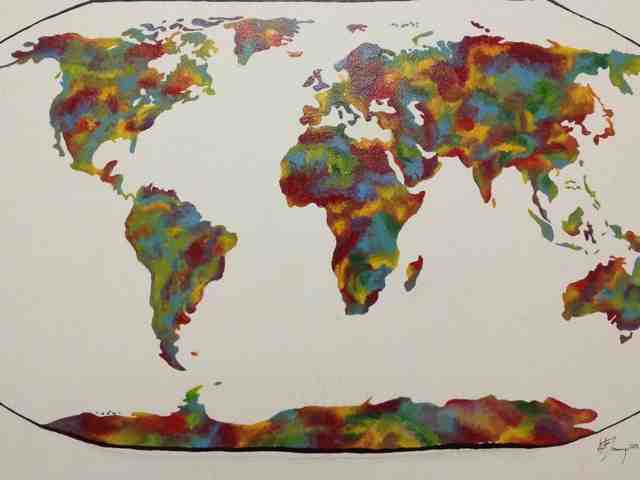
Brightstar Community School now has some of my artwork gracing its walls.
This painting is inside the older kids' classroom.
This next painting is near the front entrance to the school.
We're really going to miss Febry and Eddie, and their kids Josh and Jessica, and Miss Mika who graciously hosted us in their home for the last 2 months.
Tips on how to survive Jakarta:
1) Accept the fact that traffic is traffic. If you don't drive, take a book, or some work because five kilometres could mean three hours.
2) Hold you breath when walking down the street. Or wear a WW2 gas mask.
3) Don't drive behind a "bajaj" or "Tuc Tuc"
4) Scooters and motorbikes are the "cockroaches" of the city. They can get you places faster, but the risk of death is much higher
5) Learn the "Rat Roads" that tightly weave in-between buildings and houses, just don't get lost!
6) People stare and like to take photos of you because you're "boolay," AKA foreign. Just pretend you're famous.
7) Hang out with the locals - they know the cool spots, how to get there, and they get the best prices.
8) Take time to savour a patch of grass, if you find one.
9) Even when the heat outdoors is unbearable, bring a sweater to go into shopping malls, restaurants, cafés or hotels because the air conditioning will turn you into a Popsicle.
10) Try Indonesian food, but watch out! It's some of the spiciest food I've ever tried.
Monday, 1 July 2013
Oh Canada.
A tribute to my homeland and to the people who helped to make Canada the nation I am proud to call home.
This is a video made by JonoLaynie Photography and myself. Enjoy.
To the people at home, whom I love so dearly, I miss you.
Bali Holiday
The. Best. Holiday. Of my life... Yet.
Mini-Movie Summary

The sunset view from the airplane.
Indonesia is made up of over 17,000 Islands. Each Island speaks their own language, but everyone has a common language as well. We have been staying on the main Island of Java.
My first day in Bali, I spent scuba diving. We explored USS Liberty shipwreck located in the north of the island (Tulamben). It was the most beautiful dive I have yet experienced.

On Gili-T Island, a man trims his Bonsai Tree. This tree is 12 years old. He owns a collection of 7 trees. He refused to sell a single tree when a foreigner offered 1,000,000 rupia, because he would rather sell the entire collection as a whole.

The coral that washes up on shore has beautiful shapes and textures and are usually a dull colour compared to the live coral under the surface of the sea.

This young man (I'm so bad at remembering names) is fixing up this old boat.

The dedicated boat repair crew working into the night. There are many bicycles on the Gili Islands. There are no motorized vehicles, only horses, bicycles and the foot express.
While here, I ran around the WHOLE island. (It wasn't that big)
We also danced alot :)

The day I walked through a cloud. This is Mt. Rinjani on Lombok Island.

The view from part way up by day.

The same view at sunset.

Rinjani is an active volcano. It last errupted in 2011. The volcano is 3,726 metres (12,224ft) making it the second highest volcano in Indonesia. The volcano is surrounded by a crater lake known as "Segara Anak". The climb to this point took us one day.

Porters carried food, bedding, water and firewood up the mountian using two weaved baskets tied to either end of a bamboo stick. It was hard enough climbing with a small backpack, so I couldn't imagine how tough it would be to balance that much weight on one shoulder.

We set up camp here for the night at an elevation of 2600 metres. It was only about 10 degrees and rained a little over night.

After our climb, my legs were dead. So, here I am on a pink scooter with a Super Mario helmet.
Photo courtesy of my travel friend, Kim, from Germany.

Exploring Lombok Island on my little scooter was one of my favourite things to do. The island was free of traffic and full of nature, beautiful beaches, animals and rice fields.

Sometimes along the way I would need to stop and wait for animals to cross. I also had a rack for a surfboard on the side of my scooter, and spent lots of time on the waves.

In Ubud, Bali I visited a "Monkey Forest" with my friend Kanny. Here are two females picking things out of eachothers hair.

The little guys were just so cute!! Kanny held his hand out to one, but the protective mother scared us away.

They were play-fighting. awwww!

Monkey face.

Some rice fields.

We visited a rice field where a series of pools were created down a hillside, each draining into eachother. We had some fresh coconut milk on the hillside.

Back in Bali, most of my time was spent on the beach. The locals were very friendly and so fun to hang out with. I ate lots of local food, ran along the beach, and went surfing lots!

Some of my travel friends from Frace and Germany. They were great!

Thanks to my mom and dad for this holiday! They must really love me :)

The sunsets were breath-taking.
Thanks for the memories to everyone I met!!
Subscribe to:
Posts (Atom)